The Invisible Architecture of Team Sports
Football World Cup 2026
🌍 Read this article in your native language:
Deutsch · Français · Español · Português · Čeština · Dansk · Tiếng Việt · 中文
🏆 Current Analysis: France Leads the Field
The data is in! Our structural analysis identifies France as the team with the currently highest Winner Factor (1.122), signaling a unique internal synchronization and collective architecture.
Argentina (1.111) follows closely behind. The biggest surprise, however, is Mexico (1.105), which currently ranks third in our structural model ahead of several traditionally favored football nations.
The narrow gap between the leading teams suggests that the race remains highly competitive. Small differences in collective resilience and internal synchronization may ultimately determine who lifts the trophy.
| Rank | Team | Winner Factor |
|---|---|---|
| 1 | France | 1.122 |
| 2 | Argentina | 1.111 |
| 3 | Mexico | 1.105 |
Could this be the invisible architecture of a future world champion? Explore the structural rankings for France, Argentina, Mexico, Japan, the Netherlands, and other contenders.
Historical Evidence: Winners vs. Collapses
Do successful and collapsing teams display different collective structures? The historical comparison archive contains more than 100 structural maps across multiple national-team environments.
Germany 2014 — Champion
A team remembered for tactical discipline and extraordinary collective resilience.
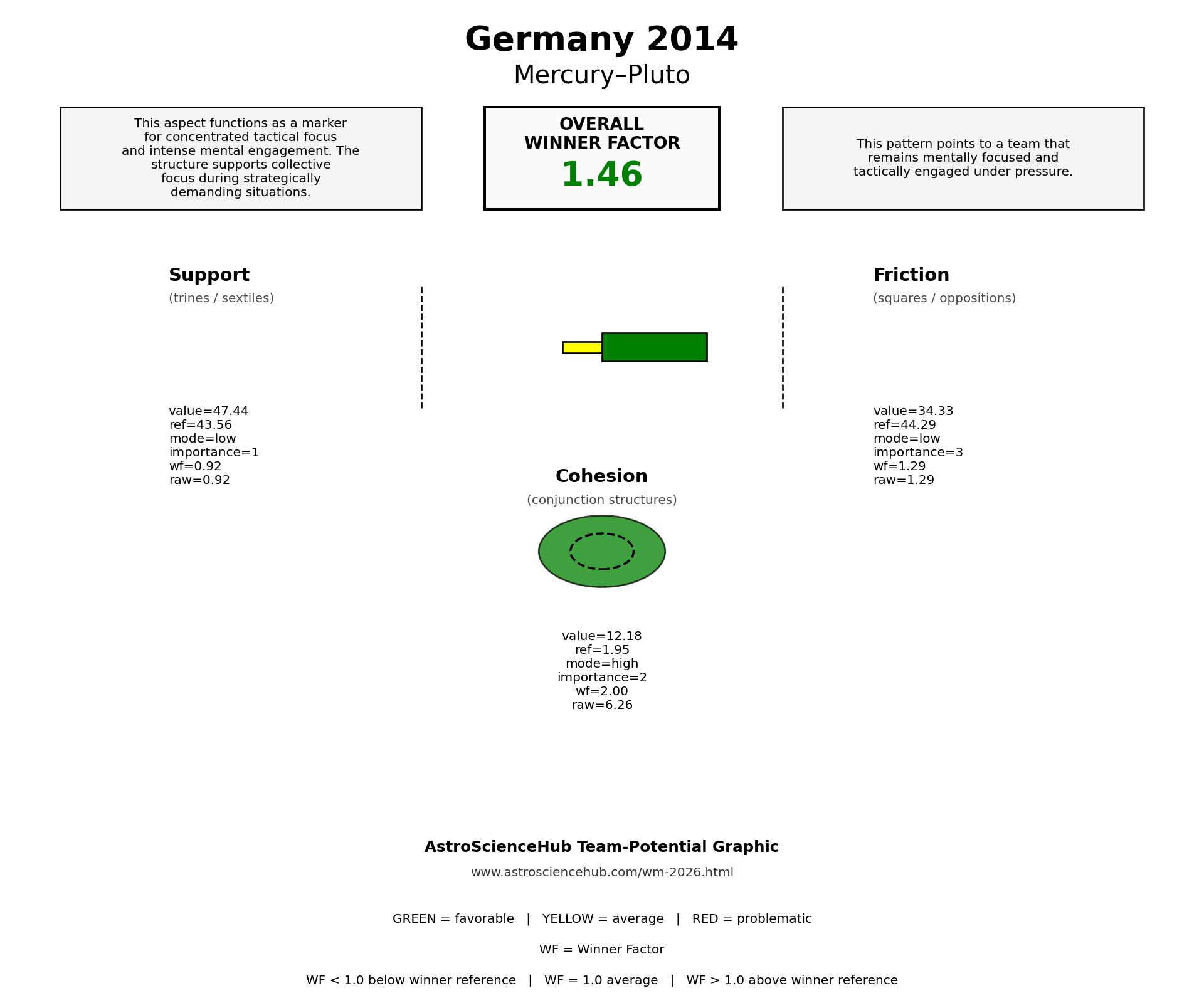
Observation: Unusually concentrated cohesion patterns and stable collective pressure alignment.
Germany 2018 — Collapse
Despite enormous individual talent, the squad appeared fragmented and tactically disconnected.
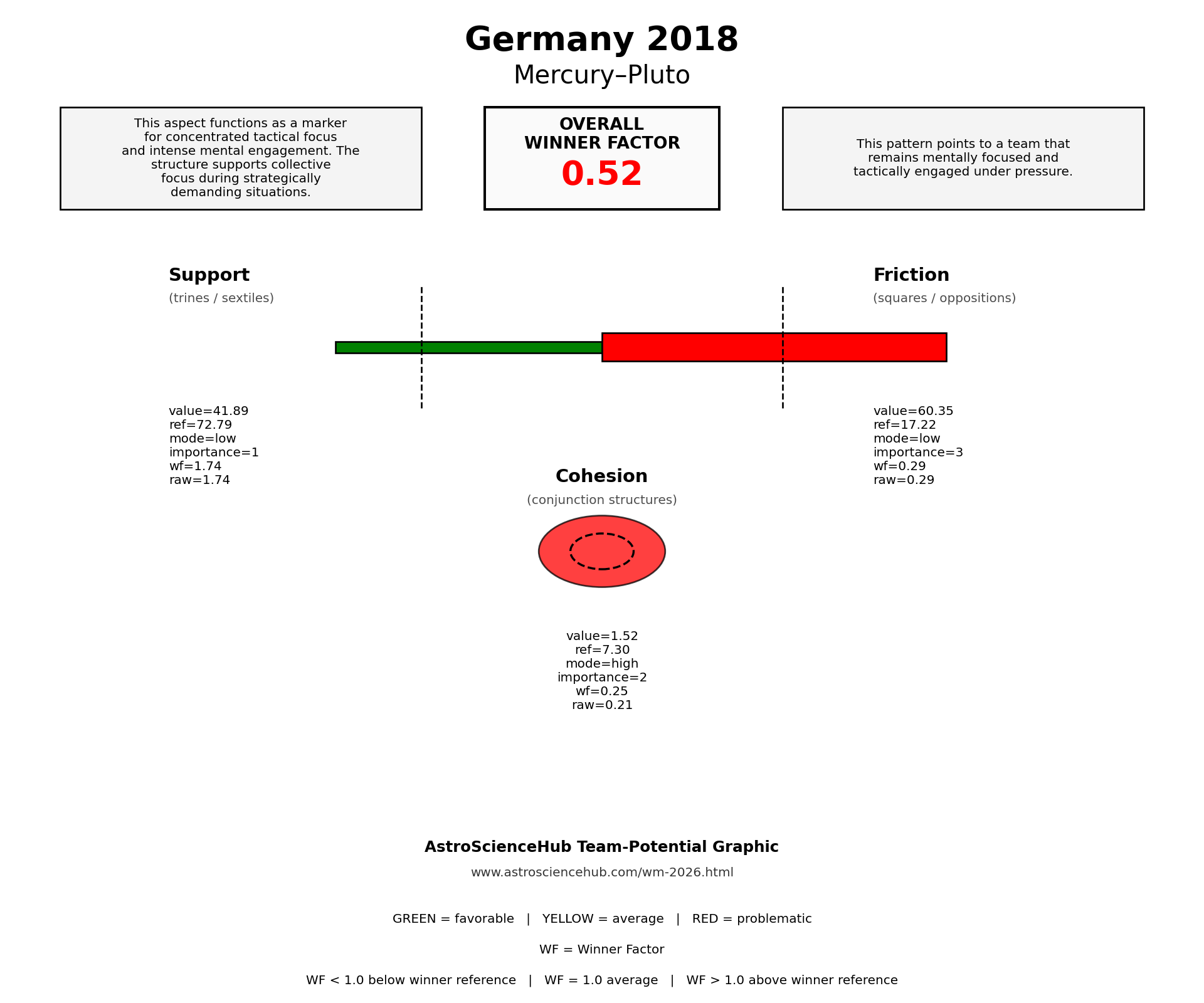
Observation: The pattern appears significantly more unstable and fragmented than reference averages.
Croatia 2018 — Finalist
A team with extraordinary emotional intensity, persistence, and fighting structure.
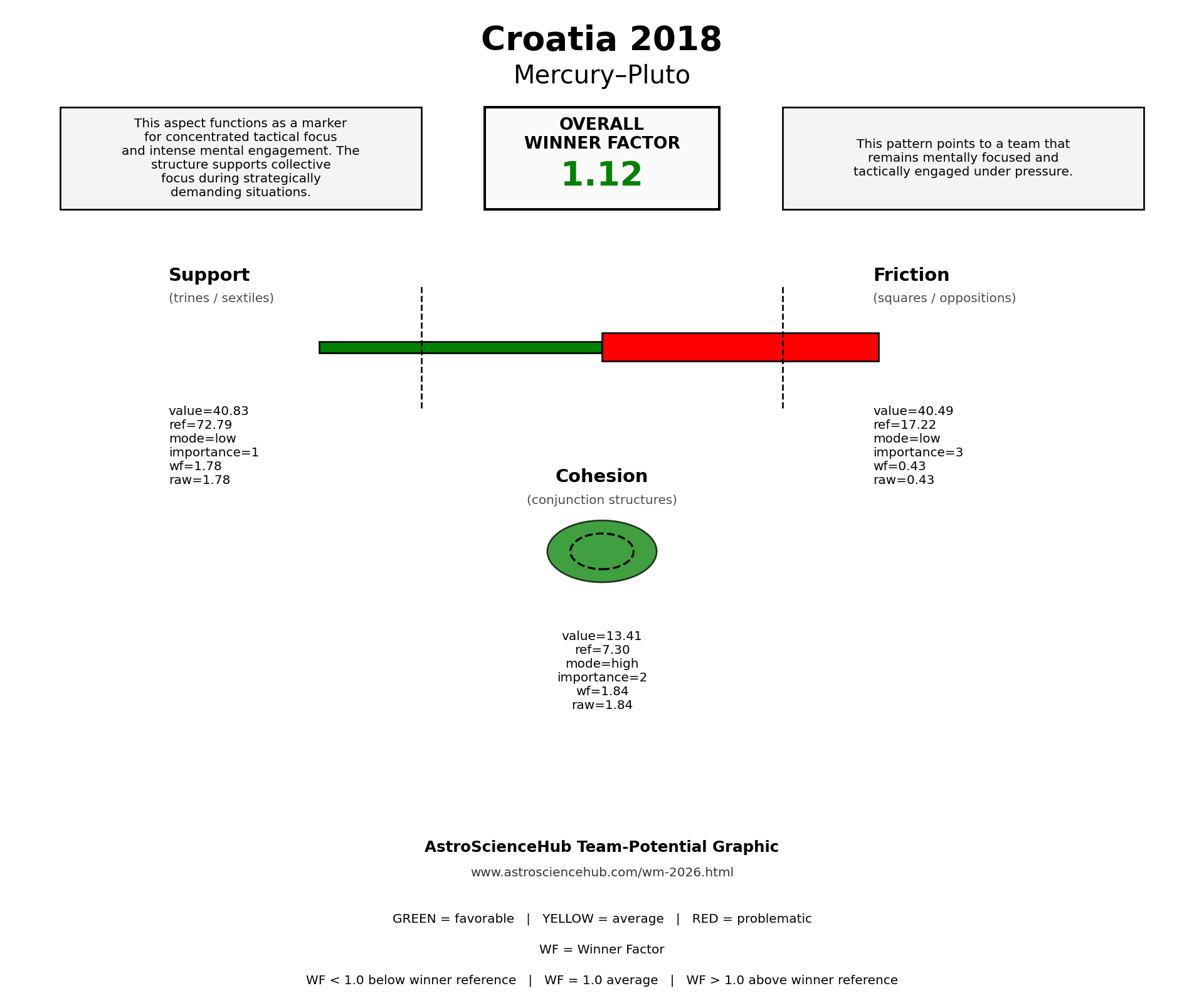
Observation: Unusually strong persistence and concentration markers across several fields.
France 2018 — Champion
A team combining tactical discipline with remarkable collective concentration.
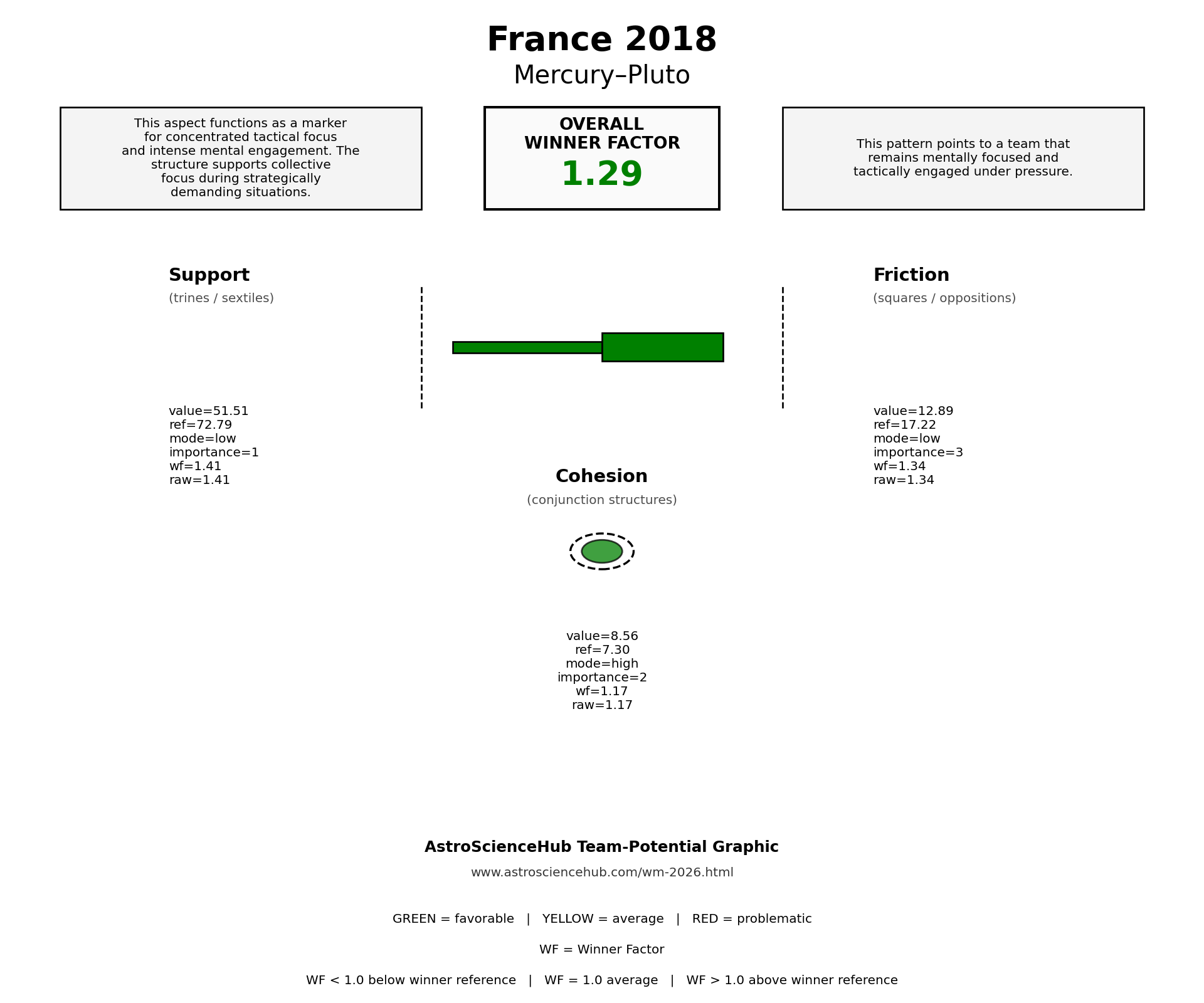
Observation: Strong collective focus and stable pressure alignment under stress.
Three Honest Realities About This Analysis
1. Football Quality Comes First
Let’s be entirely realistic: technical skill, physical conditioning, and tactical coaching are the absolute foundation of football. A structurally perfect amateur team will never beat a fragmented world-class team. But at the World Cup level, where athletic quality is nearly equal, internal relationship architecture becomes the hidden tie-breaker.
2. The Flaw of Score Predictions
Predicting exact football scores is mathematically highly unstable. A single referee decision, a wet pitch, or a deflected ball can destroy any statistical forecast. The Winner Factor does not predict random match events; it measures something deeper: a system’s resilience and capability to handle tournament pressure.
3. A Structural Language
AstroScienceHub translates the mathematical and symbolic logic of long-term relationship analytics (synastry structures) into data science. We do not treat this as supernatural prediction, but as a highly precise, formal model to visualize non-visual human dynamics and synchronization.
Why Most World Cup Predictions Fail
Football is mathematically a “Low-Scoring Game” where a single penalty, injury, or referee decision can completely ruin classic statistical models.
Before exploring our team architectures, read our sharp analytical breakdown on why deterministic forecasting is flawed—and how we focus on systemic resilience instead of random scores.
Core Interaction Fields
The visual maps simplify complex team metrics into three main symbolic dimensions. No single field determines performance—the balance and structural integration under pressure is what matters.
🟢 Support
Flowing coordination, natural tactical cooperation, and smooth team synchronization.
🔴 Friction
Internal pressure, tension, or competitive activation. Friction can be destructive, or it can intensify focus and fighting spirit.
🟡 Cohesion
Concentration, persistence, shared psychological intensity, and collective alignment.
From Team Sports to Human Relationships
If these complex relationship structures can determine the resilience and synchronization of 23 elite athletes under extreme tournament pressure — imagine what a precise structural mapping can reveal about your private partnership.
A football team is ultimately a network of human beings. So is a marriage, a family, and a business.